


Dr. Michael Pariser is a mental health coach and psychoanalytic educator based in Topanga, California, who has spent more than two decades helping clients strengthen their emotional intelligence and build lasting resilience. From 2000 to 2020, he worked as a licensed psychologist and psychoanalyst in private practice in Los Angeles, earning his Psy.D. from the California Graduate Institute in 2003 and a Doctorate in Psychoanalysis from the Institute of Contemporary Psychoanalysis in 2011, where he later served as a Training and Supervising Analyst. He now focuses his coaching practice on self-awareness, empathy, self-regulation, and interpersonal skill-building, drawing on decades of clinical experience to help clients overcome self-defeating patterns and move toward greater emotional stability. He has also led workshops, published on emotional processes, and produced instructional video content. His approach underscores just how foundational these skills are to both personal and professional success.
By now, you have doubtless been exposed to the idea of emotional intelligence. Most everyone has these days. I’m sure you’ve also heard how important it is for success in life, and maybe you’ve even been encouraged to work to improve yours.
However, when I talk to people, they often express confusion about just exactly what emotional intelligence is, and how they can go about raising their “EQ.” In this post, I’m going to describe emotional intelligence and give you a few tips at the end. In future posts, I will go into greater detail about improving your emotional abilities.
Emotional intelligence is a set of competencies, including the capacity to feel and manage your own emotions, as well as the ability to recognize and effectively respond to the emotions of others. Strong emotional intelligence correlates with positive interpersonal skills and can prove effective in both personal and professional settings, helping you navigate conflicts and maintain effective communication.
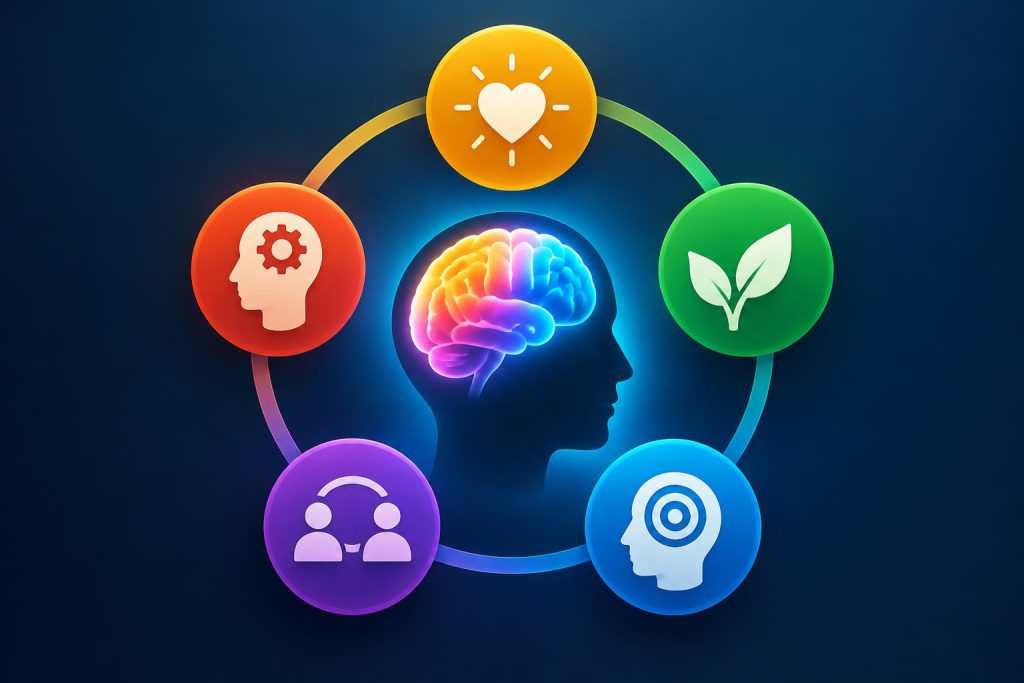
Emotional intelligence consists of five key components: self-awareness, self-regulation, internal motivation, empathy, and social skills. Daniel Goleman introduced these five components in his 1995 book Emotional Intelligence.
Self-awareness is the foremost skill of all. It means feeling your feelings and recognizing them as the prime movers of your thoughts and actions. In other words, emotional self-awareness entails being fully cognizant of your emotions and the ways in which those emotions influence your behavior, especially when it comes to interacting with other people.
Without self-awareness, you are operating in motivational darkness, reacting blindly, rather than choosing consciously. For example, you may be angry about something and not recognize that, much less grasp the underlying cause of your anger, and as a result, you may lash out at others. Obviously, this kind of behavior is likely to cause significant friction and negatively impact your personal and professional relationships.
By contrast, a strong capacity for self-awareness will allow you to identify feelings and use them to make constructive decisions that are much more likely to produce rewarding interactions.
As you become more aware of your feelings, you can enhance your ability to self-regulate. Self-regulation is the process of managing feelings and emotions in real time. Instead of acting in a rash, impulsive manner driven by unconscious emotions, self-regulation allows you to weigh both your feelings and your thoughts, so you can proceed with greater calm and groundedness.
That, in turn, will give you a greater ability to interact successfully, which can help preserve and enhance relationships with clients, peers, friends, and family.
Internal motivation is a unique aspect of emotional intelligence that manifests as ambition or drive. It triggers the creation of an achievable, desirable vision and generates the willingness to pursue that vision. Without internal motivation, you would never achieve anything.
Connected abilities include hopefulness and optimism. One important note of caution is that it’s easy to become overly ambitious or to pursue goals that can be harmful to yourself or others.
Purely material motivations do not always serve you well (although I have nothing against making money.) However, I do recommend that you thoroughly examine your wants, needs, and innermost desires, so you can seek out objectives that inspire your true passion. Such goals enable sustained motivation over long periods, keeping you focused on the tasks you need to accomplish and increasing your chances of long-term success.
Empathy is one of the single most important traits for all humans to develop. According to the American Psychological Association, empathy serves as a strong basis for many qualities critical to the benefit of society, individuals, and relationships.
Empathy allows you to not only identify the emotions another person is going through, but to understand how those emotions can make that person feel and behave. This leads to a clearer approach to interpersonal relations, making it easier to develop impactful strategies for communication and collaboration.
On top of that, the expression of empathic understanding enables others to feel “gotten,” and they are far more likely to be open to giving you what you want.
Finally, “social skills” is an umbrella term for the various capabilities you rely on to navigate the myriad of one-on-one and group interactions into which life throws you daily. Daniel Goleman defines these skills as “friendliness with a purpose,” pointing out that treating a person with basic respect and kindness is critical to personal wellness and organizational success.
The list of such skills includes, first and foremost, active listening, which entails paying close attention and making sure you understand what the other person is saying. It also entails working together to solve problems, so confrontations are mutually constructive, rather than acrimonious.
Other skills include a sense of collaboration, a willingness to work from mutual respect for each other’s desires, and an approach of assertiveness, rather than aggression or passivity.
To sum up: if you have high emotional intelligence, you do not just know how you are feeling, but also what your emotions mean, how they impact your decision-making, and what role they play in interactions with friends and co-workers. Similarly, you can identify how your emotions influence the emotions of others, as well as how their feelings impact you. As an emotionally intelligent individual, you can effectively manage your emotions, allowing you to interact well with others and making all your relationships more successful, engaging, and enjoyable.
While you can’t raise your IQ, you can take steps to enhance your EQ. Ideas for improving emotional intelligence include (1) learning to do a body scan to get more in touch with your sensations and feelings, (2) improving your active listening skills, (3) identifying your personal strengths and weaknesses, (4) increasing the time between emotional reactions and decision-making, (5) learning about non-verbal communication, and (6) learning and practicing an assertive approach to interpersonal interactions. Tips and instructions for learning these skills can be found on the internet, and I will be posting some How-To blogs in the future.
For the last suggestion, assertiveness, I have a video on Udemy. Here is a link:
https://www.udemy.com/course/the-assertiveness-formula/?couponCode=3A67DCBD6BDE600B06E5
About Dr. Michael Pariser
Dr. Michael Pariser is a mental health coach and psychoanalytic educator based in Topanga, California. He spent more than two decades as a licensed psychologist and psychoanalyst in Los Angeles, earning his Psy.D. from the California Graduate Institute and a Doctorate in Psychoanalysis from the Institute of Contemporary Psychoanalysis, where he later taught as a Training and Supervising Analyst. Today, his coaching practice emphasizes emotional self-awareness, resilience, and interpersonal effectiveness, supported by workshops, published writing, and instructional video courses on topics such as assertiveness.

